Why Krakatau
No volcano has left such a mark on the world's memory. The 1883 eruption killed more than 36,000 people, threw ash into the stratosphere, reddened the planet's sunsets for months, and made a sound heard 4,800 km away, on Rodrigues Island in the Indian Ocean. It was the first global disaster followed by telegraph, almost live.
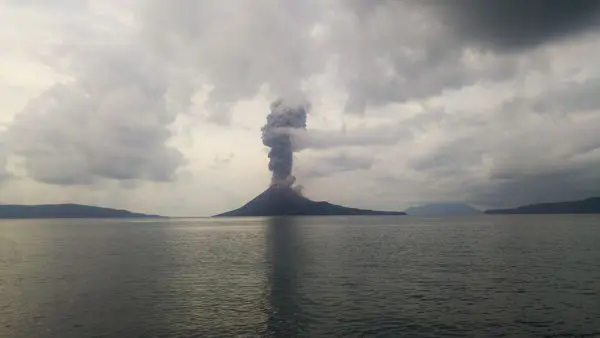
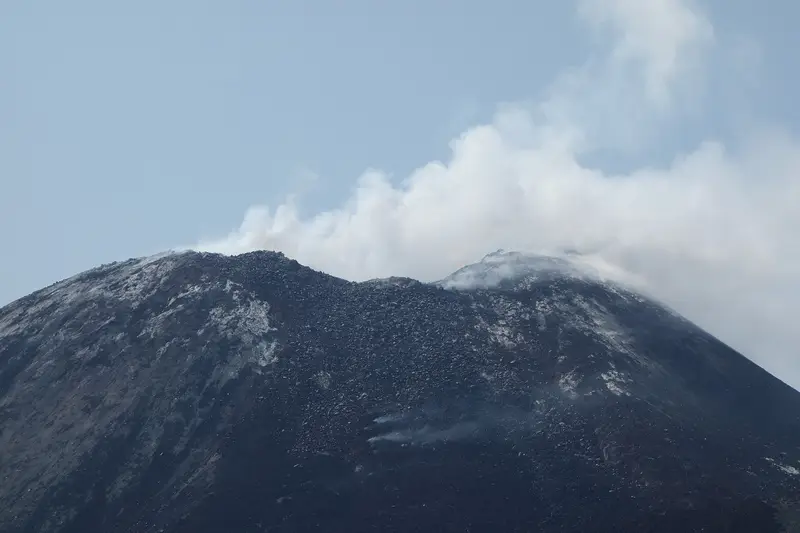
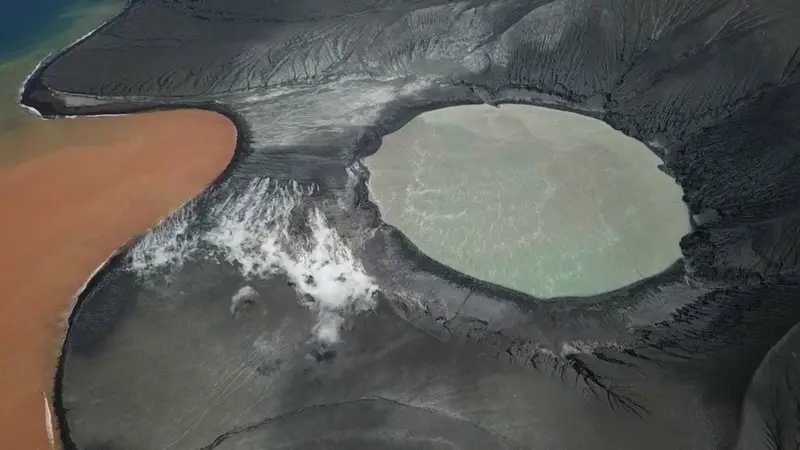
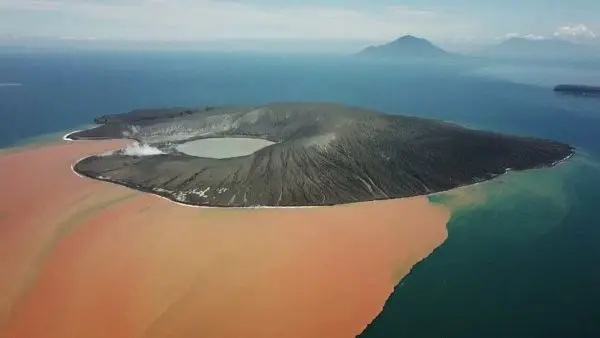
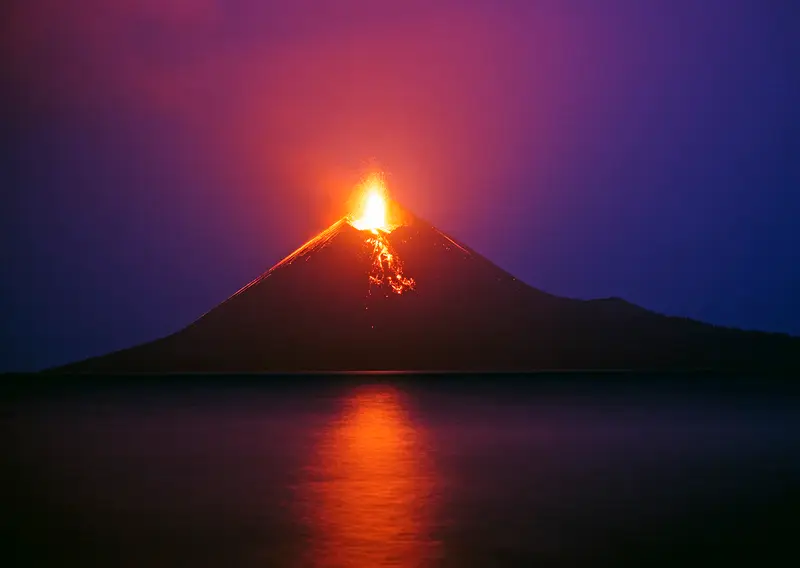
But Krakatau is not just a memory. In the caldera left by the explosion, a new volcano was born in 1927: Anak Krakatau, "the child of Krakatau". It grew about six metres a year, passed 300 m in height, partly collapsed in 2018 causing a deadly tsunami, and has been rebuilding its cone ever since, before our eyes. Few places in the world let you watch the birth of a volcanic island and life reconquering sterilised land.
Approaching Krakatau by boat, watching the child steam among its mother's cliffs, is a pilgrimage for anyone interested in volcanoes.
Krakatau at a glance
| Elevation | 157 m (Anak Krakatau, according to the PVMBG; more than 300 m before 2018) |
|---|---|
| Type | Submarine caldera 7 km wide, with an active cone in the centre |
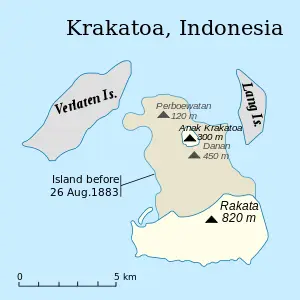
| Islands | Rakata, Sertung (Verlaten), Panjang (Lang) and Anak Krakatau |
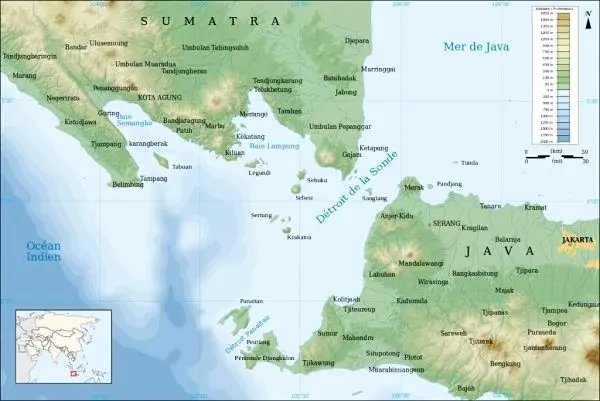
| Location | Sunda Strait, between Java and Sumatra; Lampung province |
| Eruptions | 58 recorded; 1883 (VEI 6), then Anak Krakatau almost continuously since 1927 |
| Status | Nature reserve, World Heritage with Ujung Kulon park (1991) |
| Alert level | III (Siaga), 5 km exclusion radius |
Can you go to Krakatau today?
The box next to this article gives today's status. As of 16 November 2026:
- Anak Krakatau is at level III (Siaga). The PVMBG forbids any approach within 5 km of the eruption centre, and within 1 km of the new islets that have appeared to the north-west and south-east. It warns of incandescent ballistic blocks, ash fall, lava flows and secondary explosions where lava meets the sea.
- In September 2026 the volcano had a continuous eruptive phase. According to The Jakarta Post, a boat that left Carita to film the eruption went missing; eight people, including five journalists, were being searched for.
In practice, landing on Anak Krakatau is forbidden, and so is approaching within 5 km by boat. The trips still possible stop at the outer islands, such as Rakata or Sertung, outside the zone. Check with the Lampung and Banten authorities before booking.
Getting to Krakatau
Only by sea. Two coasts serve as starting points:
- Java side (Banten): from Carita or Anyer, 3 to 4 hours by road from Jakarta. A speedboat takes about 1 h 30 to 2 h to the archipelago.
- Sumatra side (Lampung): from Canti, near Kalianda, 1 h 30 by road from Bandar Lampung. You often stop at Sebesi, the nearest inhabited island, where you can stay with locals.
Day trips leave early in the morning when the sea is calm. In the rainy season and during the transitional monsoons the strait can be very rough: do not board a small boat without life jackets or a radio.
What to do at Krakatau
When activity allowed, the classic trip included:
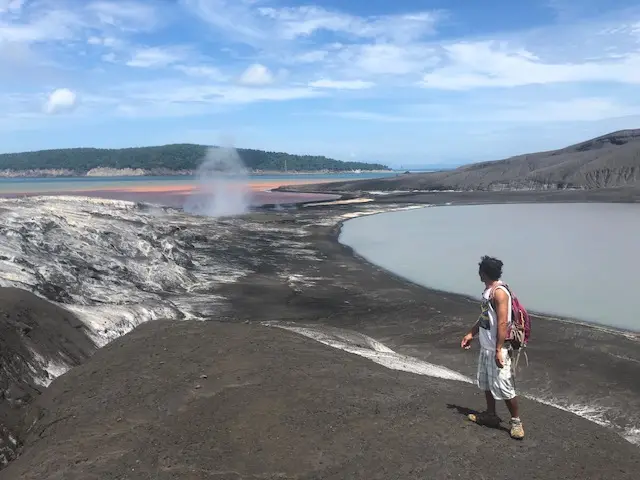
- climbing the cone of Anak Krakatau to a shoulder at 150–200 m, on black ash, with a view of the steaming crater (forbidden today);
- snorkelling at Rakata, on the Legon Cabe reefs, below the 800 m cliffs that are the remaining half of the 1883 volcano;
- a night camping on a beach on Sertung or Sebesi.
At level III, what remains is the boat tour at a distance, the reefs of Rakata and the sight of the child steaming in the distance.
The 1883 eruption
Before the disaster
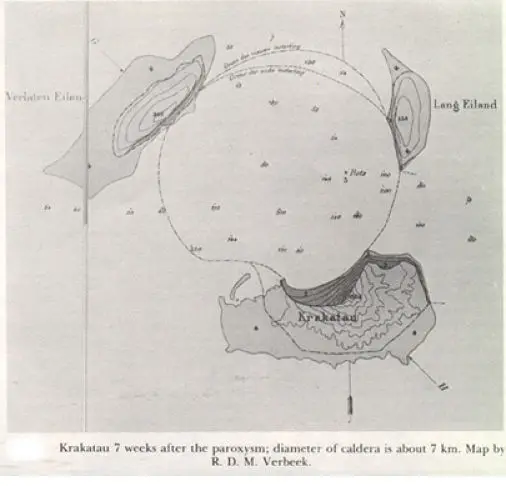
Before 1883, Krakatau island was about 9 km long and joined three cones: Rakata to the south (800 m), Danan in the centre and Perbuwatan to the north. The island itself was the remnant of an older caldera, perhaps formed in the 6th century. The last known eruption dated from 1680-1681.
The months before
On 20 May 1883 Perbuwatan erupted: an ash plume rose more than 10 km. Day-trippers from Batavia (Jakarta) even came to see it by boat. For three months the activity continued, growing stronger, with new vents.
26 and 27 August
At noon on 26 August the eruption entered its climactic phase. On 27 August four huge explosions followed one another, the strongest at 10:02 am. The sound was heard as far as Australia and the Indian Ocean. The volcano emptied and collapsed: two-thirds of the island disappeared, leaving a submarine caldera 250 m deep. Only the southern half of Rakata remained.
The tsunami
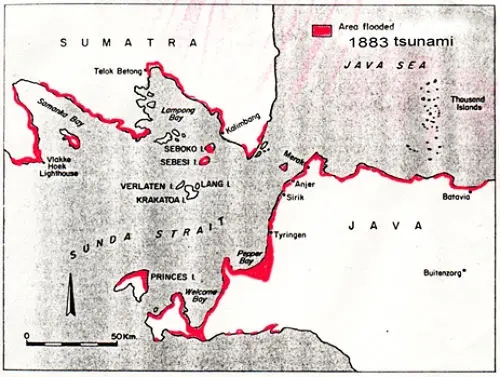
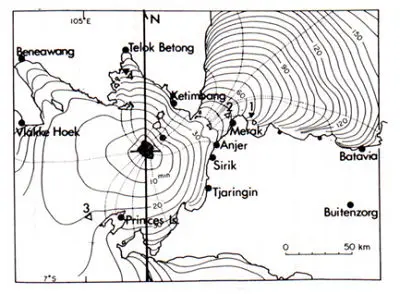
The collapse and the pyroclastic flows reaching the sea set off waves 30 to 40 m high, which swept the coasts of Java and Sumatra. The port of Merak and the town of Anjer were wiped out. A warship, the Berouw, was dropped several kilometres inland, in the Sumatran jungle. The official toll was 36,417 dead, almost all drowned.
The global consequences
The ash and sulphur aerosols injected into the stratosphere circled the globe in two weeks. For months the sunsets were so red that in New York the fire brigade was called out, thinking there were fires. The average temperature of the northern hemisphere fell by about 0.4 °C the following year. The pressure wave from the explosion was recorded seven times by barometers worldwide as it went round the Earth.
The birth of Anak Krakatau
At the end of 1927, fishermen saw steam and bubbles rising from the sea in the centre of the caldera, between the old cones of Danan and Perbuwatan. In January 1928 an islet emerged, was destroyed by the waves, and reappeared. In 1930 Anak Krakatau became a permanent island. It then grew through almost continuous eruptions: by 2017 it stood about 330 m high.
The tsunami of 22 December 2018
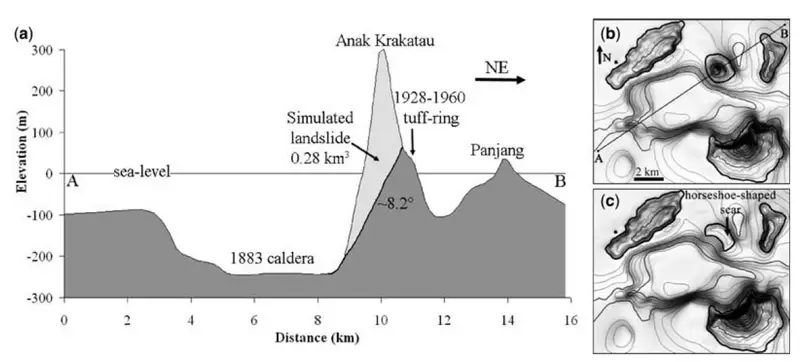
On the evening of 22 December 2018, after months of eruption, the south-west flank of Anak Krakatau collapsed into the sea. The landslide triggered a tsunami that struck the beaches of Banten and Lampung without any warning, in the middle of the holiday season. A beach concert at Tanjung Lesung was swept away live. More than 430 people died. In a few hours the volcano lost two-thirds of its height, from about 330 m to 110 m.
Scientific studies had considered this collapse as early as 2012. It led Indonesia to install warning systems for volcano-generated tsunamis, which conventional seismographs do not detect.
The volcano: how Krakatau works
Krakatau lies at the hinge between Java and Sumatra, where the subduction of the Indo-Australian plate changes direction. The Sunda Strait is a zone of crustal extension, which helps magma rise.
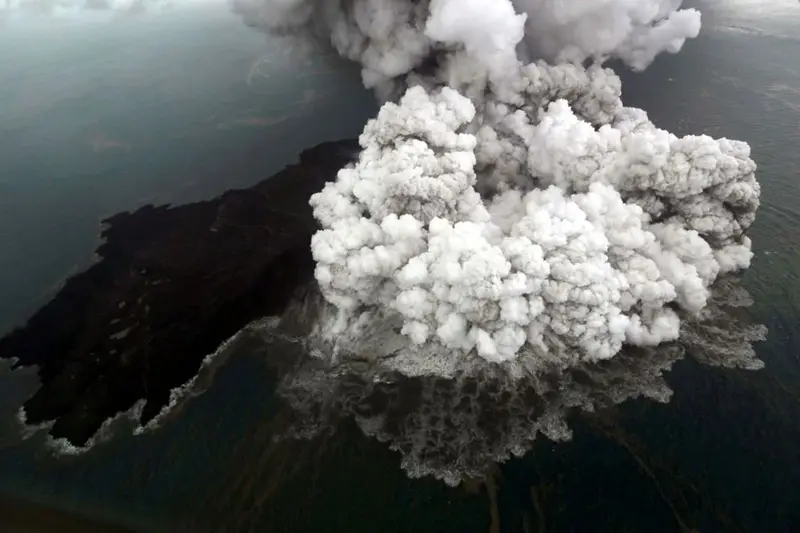
The complex has gone through several cycles: a large volcano is built, erupts cataclysmically and collapses into a caldera, then new cones are born in the caldera. 1883 is only the latest. Anak Krakatau is the start of a new cycle. Its activity alternates Surtseyan explosions (lava meeting seawater), Strombolian activity and lava flows that enlarge the island.
The eruptions of Krakatau
The Smithsonian records 58 eruptions, including a very old one around AD 535, perhaps the one that formed the prehistoric caldera. Some researchers have linked it to a global cooling at that time, but the link is still debated.
1680-1681. Eruption of Perbuwatan, described by Dutch sailors.
1883. Cataclysmic eruption (VEI 6), collapse of the island, tsunami, 36,417 dead.
1927-1930. Birth of Anak Krakatau.
1930-2017. Dozens of eruptive phases, every one to five years, of low to moderate intensity.
2018-2020. The strongest phase since the cone was born (VEI 3); collapse and tsunami on 22 December 2018.
2021-2024. A new eruptive phase, rebuilding of the cone; raised to level III in April 2022.
2026. A continuous eruptive phase in September; level III maintained in November, with new islets around the island.
Full timeline: 58 recorded eruptions
| Start | End | VEI | Location |
|---|---|---|---|
| 2021-05-25 | 2024-02-20 | 2 | Anak Krakatau |
| 2018-06-18 | 2020-04-17 | 3 | Anak Krakatau |
| 2017-02-17 | 2017-02-19 | 1 | Summit crater |
| 2014-03-31 | 2014-03-31 | 1 | Anak Krakatau |
| 2013-10-31 | 2013-10-31 | 1 | Anak Krakatau |
| 2013-03-11 | 2013-03-29 | 1 | Anak Krakatau |
| 2010-10-25 | 2012-09-09 | 2 | Anak Krakatau |
| 2009-03-25 | 2009-09-16 | 2 | Anak Krakatau |
| 2007-10-23 | 2008-08-30 | 2 | Anak Krakatau |
| 2001-07-21 | 2001-09-17 | 1 | Anak Krakatau |
| 2000-05-29 | 2000-10-30 | 1 | Anak Krakatau |
| 1999-02-05 | 1999-08-16 | 2 | Anak Krakatau |
| 1997-03-16 | 1997-05-16 | 2 | Anak Krakatau |
| 1996-07-16 | 1996-10-16 | 2 | Anak Krakatau |
| 1994-03-19 | 1995-06-16 | 2 | Anak Krakatau |
| 1992-11-07 | 1993-10-16 | 1 | Anak Krakatau |
| 1988-02-14 | 1988-04-16 | 2 | Anak Krakatau (S flank 1960-81 cone) |
| 1981-04-24 | 1981-10-20 | 1 | Anak Krakatau |
| 1980-03-15 | 1980-12-16 | 2 | Anak Krakatau |
| 1979-07-15 | 1979-11-16 | 2 | Anak Krakatau |
| 1978-07-10 | 1978-11-16 | 1 | Anak Krakatau |
| 1975-03-27 | 1975-10-26 | 2 | Anak Krakatau |
| 1972-06-10 | 1973-07-01 | 2 | Anak Krakatau |
| 1969-07-02 (uncertain) | ? | 2 | Anak Krakatau |
| 1965-07-02 | ? | 1 | Anak Krakatau |
| 1959-12-16 | 1963-07-02 | 2 | Anak Krakatau |
| 1958-10-02 | 1959-06-25 | 2 | Anak Krakatau |
| 1955-02-11 | ? | 2 | Anak Krakatau |
| 1953-09-21 | 1953-11-25 | 2 | Anak Krakatau |
| 1953-03-17 | 1953-05-01 | 2 | Anak Krakatau |
| 1952-10-10 | 1952-10-11 | 2 | Anak Krakatau |
| 1950-07-03 | 1950-07-07 | 2 | Anak Krakatau |
| 1949-05-12 | ? | 2 | Anak Krakatau |
| 1946-12-26 | 1947-08-07 | 2 | Anak Krakatau |
| 1946-07-25 | 1946-07-25 | 1 | Anak Krakatau |
| 1945-07-02 | ? | 2 | Anak Krakatau |
| 1944-07-02 | ? | 2 | Anak Krakatau |
| 1943-07-02 | ? | 2 | Anak Krakatau |
| 1942-01-29 | 1942-01-30 | 2 | Anak Krakatau |
| 1941-01-28 | 1941-02-12 | 2 | Anak Krakatau |
| 1938-07-04 | 1940-07-02 | 3 | Anak Krakatau |
| 1937-08-06 | 1937-11-23 | 2 | Anak Krakatau |
| 1936-10-13 | 1936-11-16 | 1 | Anak Krakatau |
| 1935-01-04 | 1935-07-12 | 2 | Anak Krakatau |
| 1932-11-14 | 1934-06-09 | 3 | Anak Krakatau |
| 1931-09-23 | 1932-02-17 | 2 | Anak Krakatau |
| 1927-12-29 | 1930-08-15 | 2 | Anak Krakatau |
| 1883-05-20 | 1883-10-21 | 6 | Krakatau Island (Perbuwatan, Danan) |
| 1684-02-01 | ? | 3 | |
| 1680-05 | 1681-11-19 | 3 | Perbuwatan |
| 1530 | ? | – | |
| 1320 | ? | – | |
| 1150 | ? | – | |
| 1050 | ? | – | |
| 950 | ? | – | |
| 850 | ? | – | |
| 535 | ? | 4 | |
| 250 | ? | – |
Source: Smithsonian Institution, Global Volcanism Program. VEI = Volcanic Explosivity Index, from 0 (effusive) to 8 (supervolcano); each step means ten times more material.
How Krakatau is monitored
The PVMBG follows Anak Krakatau from the Pasauran observatory on the Banten coast, and from Kalianda on the Lampung side, with seismographs on the islands, cameras and satellites. The MAGMA report of 16 November 2026 records continuous tremor.
Life returns to the islands
After 1883 all life had vanished from the archipelago. Krakatau became a world laboratory of recolonisation: in 1884 a botanist found only a spider; three years later, ferns and mosses; twenty years later, a young forest; today Rakata is covered in rainforest, with birds, reptiles and bats that came by sea and air. Anak Krakatau, regularly sterilised by its own eruptions, starts the experiment over each time.
Frequently asked questions
Can you land on Anak Krakatau?
Not in November 2026: the volcano is at level III and approach is forbidden within 5 km. In calm periods the authorities sometimes allowed landing and a climb to a shoulder of the cone.
How do you get to Krakatau from Jakarta?
By road to Carita or Anyer (3 to 4 hours), then by boat (1 h 30 to 2 h). Allow a full day, or two with a night in Carita.
Krakatoa or Krakatau?
Krakatau is the Indonesian name. Krakatoa is an English spelling, popularised by the newspapers of 1883 and by the cinema, notably the film Krakatoa, East of Java (1969), which places the volcano east of Java although it lies to the west.
How many people died in the 1883 eruption?
The official toll is 36,417 dead, almost all killed by the tsunamis on the coasts of Java and Sumatra.
Could Anak Krakatau repeat 1883?
Volcanologists believe an eruption of that size requires a large volume of magma to build up over centuries. The main risk today is another flank collapse and tsunami, as in 2018.
What is the best season?
April to October, when the strait is calmest. But the volcano's activity decides.
Sources
- MAGMA Indonesia (PVMBG), Anak Krakatau activity report of 16 November 2026
- Smithsonian Institution, Global Volcanism Program, Krakatau (262000)
- Simon Winchester, Krakatoa: The Day the World Exploded (2003)
- The Jakarta Post, 9 September 2026 (search after a boat went missing)
- Our former Krakatau guide (2018-2019, in French)
Article updated on 16 November 2026