Why Bromo
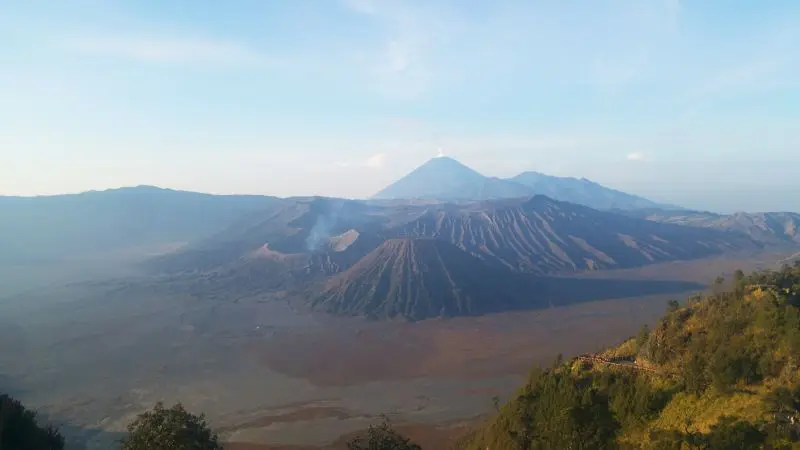
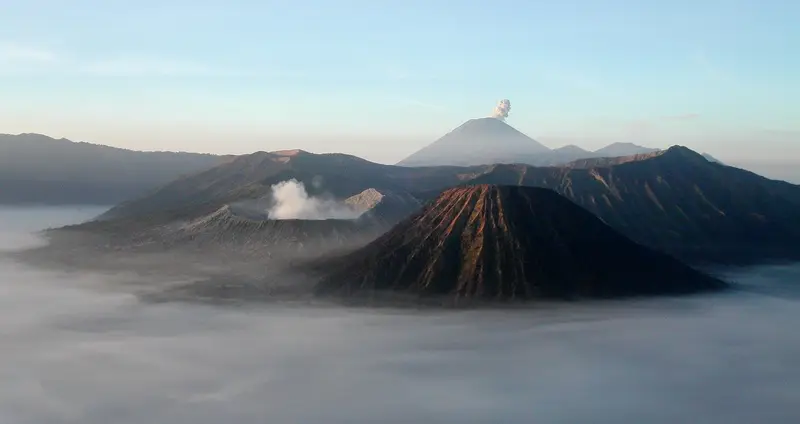
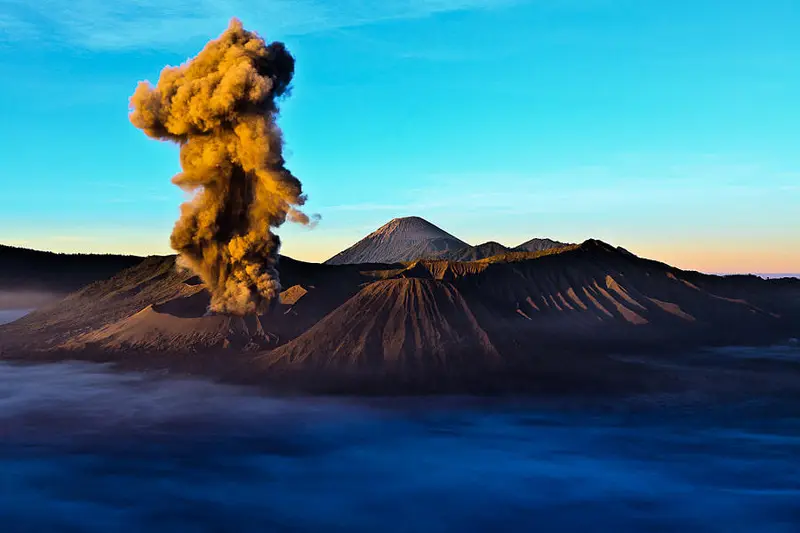
Bromo is the most photographed volcano in Indonesia, and for once the photo does not lie. Picture a huge caldera, a crater several thousand years old measuring nine by ten kilometres, its floor covered with a sea of grey-black volcanic sand. In the middle stand a Hindu temple, a perfect fluted cone (Batok), and right next to it Bromo itself, a gutted crater from which a white plume rises. Behind, 25 km away, Semeru puffs out its ash cloud every twenty minutes. At sunrise the mist fills the caldera and only the summits emerge.
What makes Bromo unique is that you experience it at every level. You can look down on it from the caldera rim, cross the sea of sand by jeep, climb the steps to the crater rim and stare into a smoking hole 800 m wide, then walk for hours along the ridges of extinct craters without meeting anyone. It is a volcano for children and seasoned hikers alike.
The downside is well known: the sunrise crowds, the touts in Probolinggo, the jeeps in single file. All of it can be avoided. That is the whole point of this article.
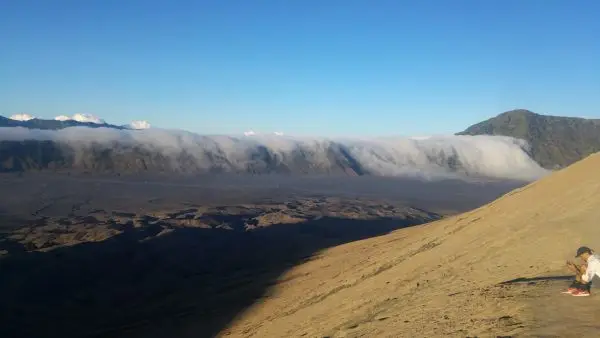
Bromo at a glance
| Elevation | 2,329 m (Bromo crater); the caldera rim tops out at 2,770 m on Penanjakan |
|---|---|
| Caldera | Sea of Sand caldera (Lautan Pasir), 9 × 10 km, within the 16 km-wide Tengger massif |
| Cones in the caldera | Bromo (active), Batok (2,440 m, extinct), Kursi, Widodaren, Watangan, Segorowedi |
| Activity | Constant degassing, regular phreatic explosions and ashfall; 72 recorded eruptions |
| Manager | Balai Besar Taman Nasional Bromo Tengger Semeru (TNBTS) |
| Entrances | Cemoro Lawang (Probolinggo), Wonokitri (Pasuruan), Ngadas – Jemplang (Malang), Ranupani (Lumajang) |
| Time needed | A morning (sunrise + crater), a full day for the hikes |
| Difficulty | Easy; 250 steps to the crater |
Is Bromo open today?
The box next to this article gives today's status, with its source and date. Bromo is open most of the time, even at alert level II, but with an exclusion zone around the crater.
- Alert level: the PVMBG has kept Bromo at level II (Waspada) for several years. The MAGMA report of 15 November 2026 describes a white plume of 50 to 600 m and asks people not to enter within one kilometre of the active crater. Above all, it points out that Bromo can produce sudden phreatic explosions without warning.
- Recent closures: the park was closed from 8 to 20 August 2026 because of a fire in the caldera, as in September 2023, when a flare used during a wedding photo shoot burned hundreds of hectares of savannah.
- Ritual closures: during the Yadnya Kasada ceremony some areas are reserved for the Tengger; the caldera is also closed to vehicles on certain days of the sacred month of Wulan Kapitu and on Nyepi.
When to go to Bromo
Bromo can be visited all year round, which is not true of East Java's other volcanoes.
- May to October (dry season): the best period, with real sunrises over a mist-filled caldera. It is cold at dawn: 2 to 8 °C at the viewpoint, sometimes less in July–August.
- November to April (rainy season): mornings are often clear, afternoons rainy. The southern savannah is bright green. Fewer people, but the sunrise can be lost in cloud.
- Avoid: weekends and Indonesian holidays (late June–July, Christmas, New Year, end of Ramadan), when several thousand people crowd onto Penanjakan.
The hour that matters: the sun rises between about 5:15 and 5:45 depending on the season. You need to be at the viewpoint by about 4:30, which means leaving around 3:30 from Cemoro Lawang, 2 am from Tumpang, or even earlier from Malang.
Getting to Bromo
Bromo has four gateways. The one you choose completely changes the experience.
Via Malang and Tumpang, the south: our recommendation
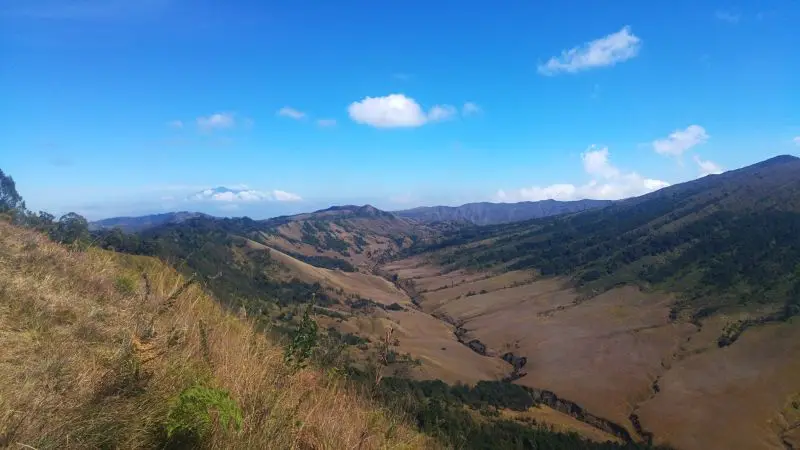
From Tumpang (20 km east of Malang), the road climbs through Gubugklakah and the Tengger village of Ngadas, with fields hanging on dizzying slopes, up to the Jemplang pass. There the caldera suddenly opens beneath your feet. The jeep drops into the green, rolling southern savannah, then crosses the whole sea of sand to Bromo. It is the most beautiful access, the least crowded, and the only one that really crosses the caldera instead of stopping at its rim.
Private cars cannot go beyond Jemplang: the caldera is crossed by 4×4 jeep with a Tengger driver. Price guide:
| Jeep trip (5 seats) | Indicative price |
|---|---|
| Tumpang → Cemoro Lawang, no sunrise | 650,000 IDR (≈ 33 €) |
| Tumpang → sunrise + crater → Tumpang | 900,000 IDR (≈ 45 €) |
| Malang → sunrise + crater → Malang | 1,000,000 IDR (≈ 50 €) |
If you sleep in Gubugklakah, at Maison Manendra, you leave around 2 am instead of midnight from Malang.
Via Probolinggo and Cemoro Lawang, the north: the classic gateway
This is the tour-bus route: Surabaya → Probolinggo (2 h by train or bus), then minibus to the village of Cemoro Lawang, perched on the northern rim of the caldera. The advantage: you sleep 10 minutes from the crater and can do everything on foot. The drawback: Probolinggo has a well-earned reputation for tourist traps, with fake information desks, overpriced bus tickets and private "tourist offices". Price guide: public minibus 50,000 IDR (≈ 3 €) per person (it leaves when full), private car 350,000 IDR (≈ 18 €), motorbike taxi 250,000 IDR (≈ 13 €).
If you go this way, buy your entrance ticket online, pay nothing at the Probolinggo bus station and turn down middlemen.
Via Pasuruan and Wonokitri, the north-west
The Wonokitri (Tosari) road leads straight to Penanjakan, the highest viewpoint. It is the most practical access from Surabaya for a quick round trip, but also the one most sunrise jeeps use. Simple accommodation in Tosari and Wonokitri.
Via Lumajang and Ranupani, the south-east
The road up to Semeru joins the caldera via Ranupani and Jemplang. It is the natural follow-on after climbing Semeru.
From Bali and Yogyakarta
- Bali: ferry from Gilimanuk to Ketapang (Banyuwangi), then train to Probolinggo or Malang. Or fly to Surabaya. Most travellers combine it with Kawah Ijen on the way.
- Yogyakarta: direct train to Malang (7 to 8 h) or Probolinggo.
How to see Bromo: six ways to do it
1. Sunrise at Penanjakan, by jeep
The agencies' classic: jeep at about 3:30, Penanjakan viewpoint (2,770 m) for sunrise, then down into the sea of sand and up to the crater. The 360° view is the best of all. But in season and at weekends you will mostly see the backs of hundreds of people. Tip: stay until 6:30–7, the crowd leaves quickly and the light gets better.
2. Sunrise on foot from Cemoro Lawang
From the village, a path follows the caldera rim north-west, between onion and cabbage fields, then climbs by steps. Several viewpoints follow one another: Seruni Point, King Kong Hill, then Penanjakan. The higher you go, the fewer people. Allow 45 minutes to 1 h 30. It is free if you stay outside the park boundary, and it is often more beautiful than Penanjakan, because you are closer to Bromo.
3. Bromo crater
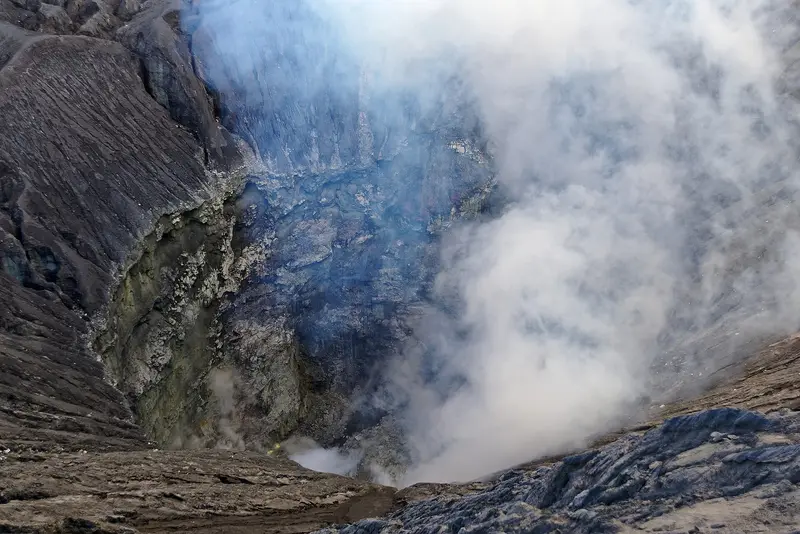
From the jeep car park you cross the sea of sand on foot (20 minutes) or on horseback, pass the Pura Luhur Poten temple, then climb about 250 steps to the crater rim. At the top, a narrow ridge overlooks a smoking chasm from which come a dull rumble and a smell of sulphur. Allow one hour there and back. On days when the wind is wrong, the plume blows down onto the ridge: a damp scarf helps.
4. The Bromo and Kursi ridge traverse: our favourite hike
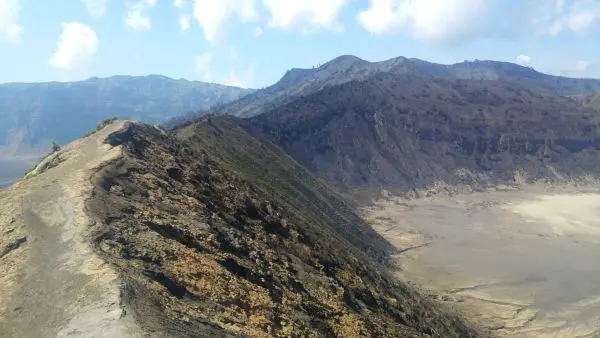
At the top of the steps, instead of going back down, turn left and follow the crater ridge. After a few minutes the crowd disappears. The ridge leads to old extinct craters, then to a promontory overlooking the whole caldera. You meet almost no one. This walk is only possible when the wind pushes the gas east and the exclusion radius allows it, and it is not recommended for people prone to vertigo. With a guide you go straight down into the caldera, where the jeep is waiting.
5. Mount Batok
The fluted, extinct pyramid next to Bromo can be climbed in 2 h 30 there and back from the car park. The climb is very steep, with no marked path near the top, but at the summit you will be alone with a view of Bromo crater that nobody else has. Check that it is allowed on the day.
6. The southern caldera rim and B29
From the Jemplang–Ranupani road, a path follows the southern rim of the caldera through forest to the summit called B29 (and its neighbour B30), above the village of Argosari. The view takes in both Bromo and Semeru. B29 can also be reached by motorbike from Lumajang, and it has become a popular sunrise viewpoint with Indonesians.
And also
- The southern savannah, nicknamed Bukit Teletubbies by Indonesians for its round green hills, superb from December to May.
- Pasir Berbisik, the "whispering sand", the part of the sea of sand made famous by a 2001 Indonesian film.
- Mentigen and Bukit Cinta, two small, easy viewpoints near Cemoro Lawang.
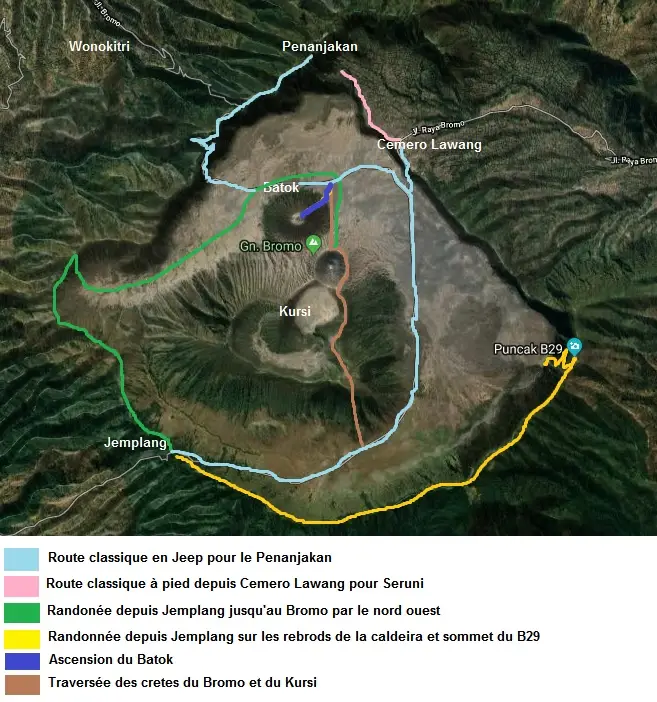
Map and GPX track
- Cemoro Lawang → mer de sable → cratère du BromoDistance 2.6 km · Elevation gain 117 m · Start 2,223 m → High point 2,271 mDownload the GPX track ↓
- Cemoro Lawang → King Kong Hill → PenanjakanDistance 4.2 km · Elevation gain 483 m · Start 2,223 m → High point 2,693 mDownload the GPX track ↓
Indicative route from OpenStreetMap; elevations from Copernicus. Check on the ground and follow your guide. © OpenStreetMap, OpenTopoMap (CC-BY-SA), Open-Meteo.
How much does Bromo cost?
The entrance fee
For a foreign visitor, park entry costs 255,000 IDR (≈ 13 €) per person per day, on weekdays and weekends alike. The ticket is bought online on the park's official website (bromotenggersemeru.id). It includes insurance; since 2026 you receive a wristband at the entrance, red for foreigners. Without an official ticket, the fine is five times the ticket price.
The jeep
This is the main cost: see the price guide above. A jeep takes five people, hence the value of sharing. Prices are set by the Tengger cooperatives that hold the jeep monopoly in the caldera.
The rest
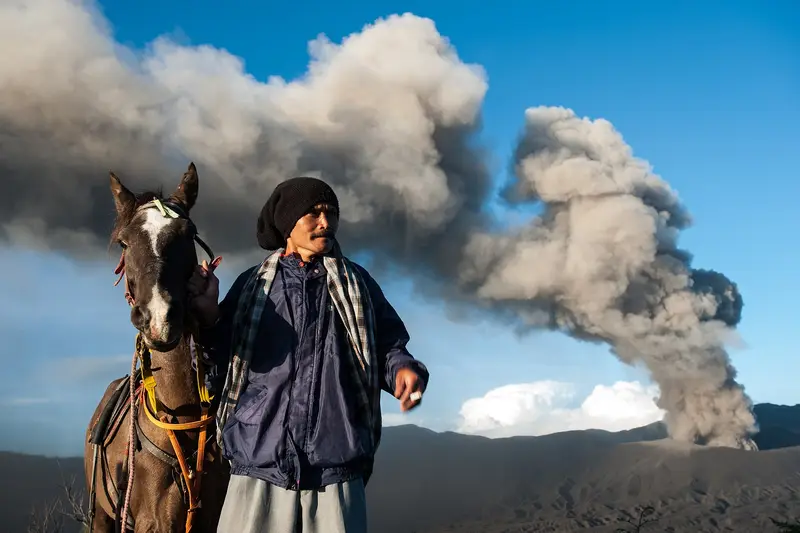
Horses to cross the sea of sand, breakfast at a warung, dust masks. The horses are run by Tengger villagers; agree the price before getting on.
With Terre des Volcans
Our private-jeep Bromo trip from Tumpang or Malang starts at 220,000 IDR (≈ 11 €) per person for a full group. Bromo is also part of three of our tours.
Our Bromo trips
Bromo at sunrise
Private jeep from Tumpang or Malang through the southern gate of the caldera: the one the coaches do not use.
- 1 day(s)
- ●●●●● Stroll
- Start : Tumpang / Malang
- Can depart any day · max. 5 people
from 220,000 IDR ≈ 11 € per person
Itinerary
- Day 1 — Sunrise, crater and Sea of Sand
Night departure by jeep via Ngadas and Jemplang. Sunrise from a viewpoint away from the crowd, then the Sea of Sand, the 250 steps to the crater rim and back through the savannah. Return around 11:00.
Departures
- Tumpang — 02:00
| Group size | Price per person | Approx. |
|---|---|---|
| 1 person (solo) | 1,100,000 IDR | ≈ 55 € |
| 2 people | 550,000 IDR | ≈ 28 € |
| 3 people | 370,000 IDR | ≈ 19 € |
| 4 people | 275,000 IDR | ≈ 14 € |
| 5 people | 220,000 IDR | ≈ 11 € |
Entrance fees to add: Bromo : 255,000 IDR (≈ 13 €) per day, per person × 1.
Included
- Air-conditioned car with driver
- 4×4 jeep with driver
Not included
- Park entrance fees (amount shown above)
- Lunches and dinners outside the trek
- Tips
- Travel and evacuation insurance
Options
- Guide for a 3 to 6-hour hike inside the caldera — 700,000 IDR (≈ 35 €) per group
- Transfer Surabaya (station, airport, city) → Tumpang — 650,000 IDR (≈ 33 €) per vehicle (max. 5 people)
- Night at Maison Manendra before or after, double room with breakfast — 600,000 IDR (≈ 30 €) per room (2 people)
Combine it in a tour
Bromo – Kawah Ijen
East Java's two classics in three days, from Malang to the Bali ferry, without a single wasted hour on the road.
from 3,200,000 IDR ≈ 160 €
Semeru – Bromo
Three days in one massif: the Semeru trek first, the Bromo caldera as the reward.
from 3,800,000 IDR ≈ 190 €
Semeru – Bromo – Kawah Ijen
The great East Java traverse: three active volcanoes in four days, from Malang to the doorstep of Bali.
from 5,500,000 IDR ≈ 275 €
What to bring
- Warm clothes: it is between 2 and 8 °C at the viewpoint at dawn. Hat, gloves, light down jacket. You can buy them on the spot, often of poor quality.
- A mask or scarf against the dust of the sea of sand and the crater gases.
- Good shoes: the sand is slippery on the steps and ridges.
- A head torch for the viewpoint paths before dawn.
- Protect your camera gear: the ash is fine, abrasive and gets everywhere. Contact lens wearers will have a bad morning.
Mistakes to avoid
- Going through Probolinggo unprepared. That is where most scams happen.
- Staying put at Penanjakan. Ten minutes' walk into the forest is often enough to find a quiet spot.
- Leaving as soon as the sun is up. The best light, and an empty caldera, come between 6:30 and 8.
- Ignoring the exclusion radius. Bromo has already killed tourists on the crater rim.
- Coming on a Saturday in July. If you have no choice, do the sunrise on foot from Cemoro Lawang.
The Tengger, guardians of Bromo
Some 100,000 Tengger people live in about thirty villages on the massif, from Ngadas to Wonokitri and from Cemoro Lawang to Ranupani. According to tradition, they descend from the last followers of the Hindu Majapahit empire, who took refuge in the mountains when Islam spread across Java in the 15th century. They practise a Hinduism blended with Buddhism and older beliefs, speak an archaic Javanese dialect, and grow potatoes, cabbages and leeks on impossible slopes.
The legend of Roro Anteng and Joko Seger
The name Tengger is said to come from Roro Anteng and Joko Seger, a princely couple who, unable to have children, prayed to the god of the mountain. The god granted them twenty-five children, on condition that the last be sacrificed to him. When the couple tried to break their promise, the volcano awoke and swallowed the youngest, Raden Kusuma. Before disappearing, he asked his brothers and sisters to bring offerings to the crater every year.
Yadnya Kasada
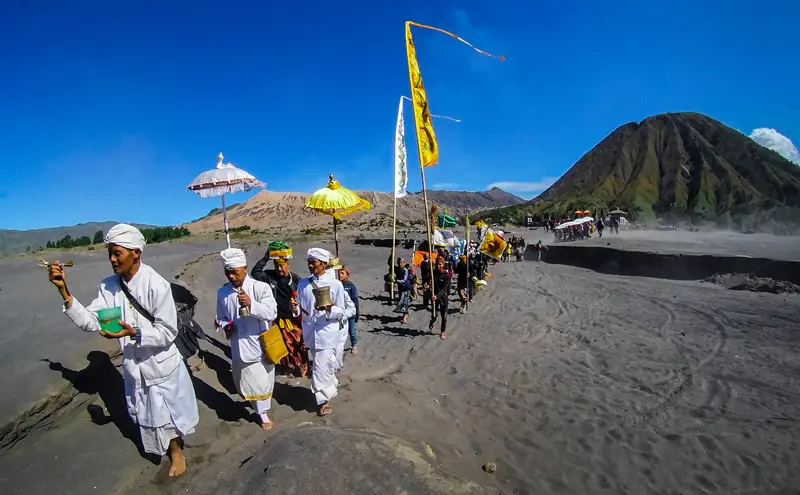
Ever since, every year on the 14th day of the month of Kasada in the Tengger calendar (June or July depending on the year), thousands of Tengger gather at night at the Pura Luhur Poten temple at the foot of Bromo. Before dawn they climb to the crater and throw vegetables, fruit, chickens, money and flowers into the abyss. On the crater wall, villagers try to catch the offerings. The ceremony now also draws many visitors. If you come at that time, find out about the reserved areas and be discreet.
The history of climbing Bromo
Bromo was never a mountain to be "conquered". The Tengger have climbed to the crater for centuries, for Kasada. The first European accounts appear in the early 19th century: Thomas Stamford Raffles, British governor of Java from 1811 to 1816, describes the Tengger and their rites in his History of Java (1817), and the German naturalist Franz Wilhelm Junghuhn, who travelled Java's volcanoes in the 1840s, left descriptions and drawings of the caldera that remain among the most precise of the 19th century.
In colonial times Bromo became a fashionable excursion for residents of Surabaya and Malang, who rode up on horseback from Tosari, then a renowned hill station. Mass tourism arrived in the late 20th century, with Bromo–Ijen tours sold from Bali and Yogyakarta. The national park, created in 1982, now manages the entrances, ticket sales and jeep traffic.
The volcano: the Tengger caldera
The Tengger massif is one of the oldest volcanic complexes in East Java: its history goes back about 820,000 years. It is made up of five stacked stratovolcanoes, each beheaded by a caldera. The most recent, the Sea of Sand caldera, formed in stages in the late Pleistocene and early Holocene, a few thousand to a few tens of thousands of years ago.
After the collapse, a cluster of small cones grew on the caldera floor: Batok, Kursi, Widodaren, Watangan, Segorowedi and Bromo, the youngest and the only active one. The sea of sand itself is made of accumulated ash reworked by wind and rain.
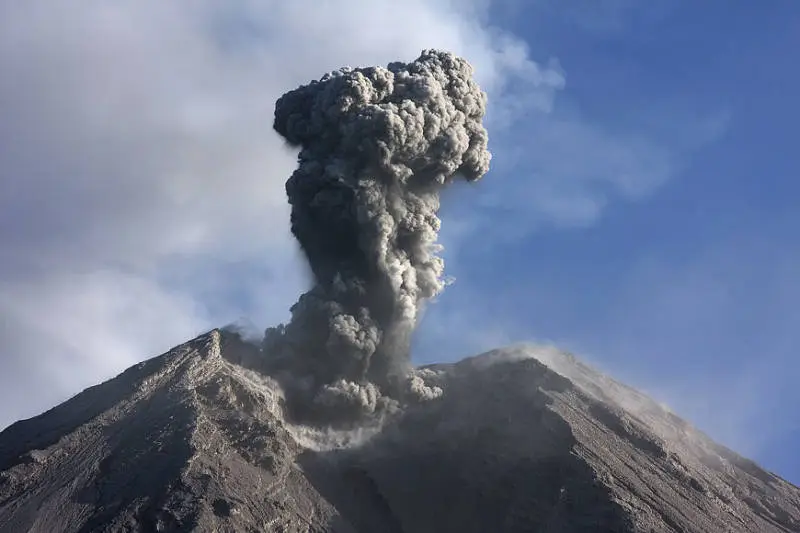
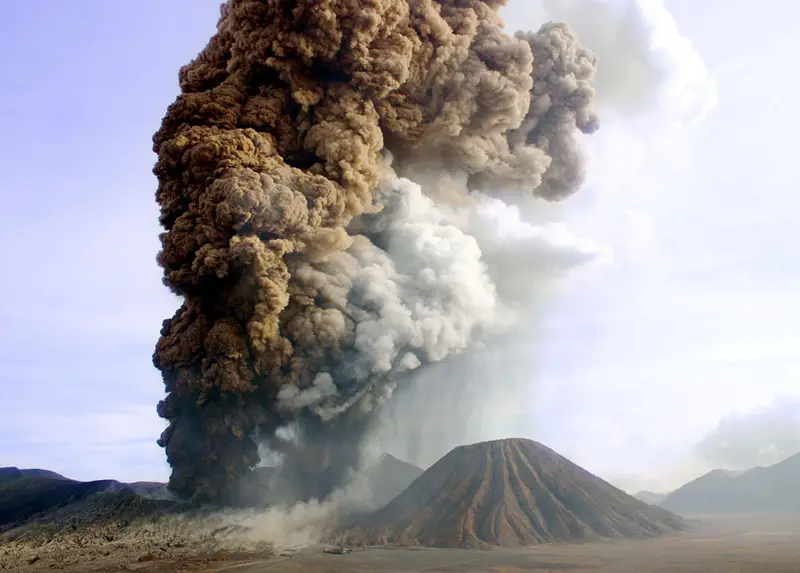
Bromo's magma is a trachyandesite, slightly richer in alkalis than that of its neighbours. But most of its activity is not magmatic: it consists of phreatic explosions, caused by groundwater flashing to steam on contact with hot rock. They are sudden and throw blocks around the crater, hence the safety radius.
The eruptions of Bromo
The Smithsonian records 72 eruptions in the Tengger caldera, about sixty of them at Bromo since the early 19th century. The caldera itself had a large explosive eruption around 830 BCE.
19th century. Bromo erupts every two to five years: explosions and ashfall on the Tengger villages.
1915–1916 and 1948. Two stronger eruptions (VEI 3), with ashfall as far as Probolinggo.
1995 and 2000–2001. Moderate explosive phases, ashfall on crops.
8 June 2004. A sudden phreatic explosion throws blocks onto the crater rim: two tourists are killed. This is the origin of today's safety radius.
November 2010 to 2011. The strongest recent eruption (VEI 3): ash plumes several kilometres high for months, flights disrupted at Malang and Bali, crops destroyed. The crater glows at night.
November 2015 to 2016. Another ash phase lasting several months. The crater remains open to visitors part of the time.
2019, 2020 and December 2023. Brief ash eruptions, a few days of restrictions.
2026. Level II, intense degassing and small earthquakes: Bromo is breathing, as usual.
Full timeline: 72 recorded eruptions
| Start | End | VEI | Location |
|---|---|---|---|
| 2023-12-13 | 2023-12-13 | 1 | |
| 2021-04-15 (uncertain) | 2021-10-22 | 0 | Bromo |
| 2020-12-26 | 2020-12-28 | 1 | |
| 2019-02-18 | 2019-07-28 | 2 | Bromo |
| 2015-11-12 | 2016-11-12 | 2 | Bromo cone |
| 2010-11-26 | 2011-06-13 | 3 | Bromo |
| 2004-06-08 | 2004-06-24 | 2 | Bromo |
| 2000-11-29 | 2001-01-15 | 2 | Bromo |
| 1995-09-09 | 1995-12-16 | 1 | Bromo |
| 1995-03-03 | 1995-05-26 | 1 | Bromo |
| 1984-05-12 | 1984-05-31 | 1 | Bromo |
| 1983-12-21 | 1983-12-21 | 1 | Bromo |
| 1983-04-15 (uncertain) | 1983-06-28 | 1 | Bromo |
| 1980-06-05 | 1980-09-20 | 2 | Bromo |
| 1972-01-26 | 1972-03-16 | 2 | Bromo |
| 1956-06-16 | 1956-07-16 | 2 | Bromo |
| 1955-12-29 | 1955-12-30 | 2 | Bromo |
| 1950-05-27 | 1950-08-16 | 2 | Bromo |
| 1948-02-15 | 1948-04-25 | 3 | Bromo |
| 1940-04-25 | 1940-07-03 | 2 | Bromo |
| 1939-06-24 | 1939-07-16 | 2 | Bromo |
| 1935-07-16 | ? | 2 | Bromo |
| 1930-05-30 | 1930-07-16 | 2 | Bromo |
| 1929-08-07 | 1929-09-08 | 2 | Bromo |
| 1928-12-16 | ? | 2 | Bromo |
| 1928-03-15 | 1928-07-16 | 2 | Bromo |
| 1922-02-05 | 1922-06-20 | 2 | Bromo |
| 1921-06-16 | 1921-10-17 | 2 | Bromo |
| 1915-11-16 | 1916-06-16 | 3 | Bromo |
| 1910-01-18 | 1910-01-21 | 2 | Bromo |
| 1909-01-12 | 1909-01-14 | 2 | Bromo |
| 1907-12-14 | 1908-02-13 | 2 | Bromo |
| 1907-08-28 | ? | 2 | Bromo |
| 1906-09-25 | 1907-05-18 | 2 | Bromo |
| 1896-07-02 | ? | 2 | Bromo |
| 1893-01-13 | 1893-03-27 | 2 | Bromo |
| 1890-05-16 | 1890-09-16 | 2 | Bromo |
| 1888-02-27 (uncertain) | ? | 2 | Bromo |
| 1886-11-11 | 1887-01-25 | 2 | Bromo |
| 1886-04-15 | 1886-04-26 | 2 | Bromo |
| 1885-10-31 | 1886-01-10 | 2 | Bromo |
| 1885-06-16 | ? | 2 | Bromo |
| 1877-04-24 | ? | 2 | Bromo |
| 1867-12-13 | 1868-01-12 | 2 | Bromo |
| 1866-07-16 | ? | 2 | Bromo |
| 1865-12-01 | 1865-12-18 | 2 | Bromo |
| 1865-04-16 | 1865-05-16 | 2 | Bromo |
| 1860-06-12 | 1860-06-14 | 2 | Bromo |
| 1859-01-30 | 1859-03-04 | 2 | Bromo |
| 1858-10-18 | ? | 2 | Bromo |
| 1858-03-04 | ? | 2 | Bromo |
| 1857-07-02 | ? | 2 | Bromo |
| 1856-09-10 | ? | 2 | Volcano Uncertain |
| 1844-11-09 | ? | 2 | Bromo |
| 1843-01-16 | ? | 2 | Bromo |
| 1842-01-24 | 1842-06-16 | 2 | Bromo |
| 1835-07-02 | ? | 2 | Bromo |
| 1830-12-15 | 1830-12-16 | 2 | Bromo |
| 1830-03-03 | ? | 2 | Bromo |
| 1829-11-05 | 1829-11-11 | 2 | Bromo |
| 1825-11-05 | 1825-11-08 | 2 | Bromo |
| 1822-12-28 | 1823-01-05 | 2 | Bromo |
| 1820-07-02 | ? | 2 | Bromo |
| 1815-04-05 | 1815-04-17 | 2 | Bromo |
| 1804-09-16 | ? | 2 | Bromo |
| 1775 (uncertain) | ? | – | Bromo |
| 1767 (uncertain) | ? | – | Bromo |
| 1590 | ? | 2 | Bromo |
| 330 | ? | 3 | Segorowedi |
| 190 | ? | 2 | Widodaren |
| 830 BCE | ? | 4 | Sandsea caldera |
| 5260 BCE | ? | – | Sandsea caldera |
Source: Smithsonian Institution, Global Volcanism Program. VEI = Volcanic Explosivity Index, from 0 (effusive) to 8 (supervolcano); each step means ten times more material.
How Bromo is monitored
The PVMBG monitors Bromo from the Cemoro Lawang observatory on the northern rim of the caldera. The reports, published daily on MAGMA Indonesia, describe the colour and height of the plume, the earthquakes (low-frequency, hybrid, tremor) and the recommendations. The report of 15 November 2026 records two low-frequency earthquakes, three hybrid earthquakes and a plume of up to 600 m.
Bromo and Ijen: the East Java combo
Nine travellers out of ten combine Bromo and Kawah Ijen. The two sites are about 250 km apart. You can do it all by car in seven hours on the road, but we prefer the train from Probolinggo to Banyuwangi: four hours across East Java, safer and more restful. See our Bromo – Kawah Ijen tour. If you have two more days and the legs for it, add Semeru.
In pictures
Frequently asked questions
Is Bromo worth it despite the crowds?
Yes, if you choose your access and your timing. Via Tumpang and the southern savannah, staying on after sunrise, walking the ridges or going to B29, you see Bromo without the crowds. The landscape disappoints nobody.
What is the Bromo entrance fee?
255,000 IDR (≈ 13 €) per person per day for a foreign visitor, insurance included, bought online on the park's official website. The price is the same on weekdays and at weekends.
What time should you leave for sunrise?
The sun rises between 5:15 and 5:45. Leave around 3:30 from Cemoro Lawang, around 2 am from Tumpang or Gubugklakah, around 1 am from Malang.
Malang or Probolinggo for Bromo?
Malang (via Tumpang) for the beauty of the road, the crossing of the caldera and the absence of scams. Probolinggo (via Cemoro Lawang) to sleep on the caldera rim and do everything on foot, provided you avoid the town's traps.
Can you visit Bromo without an agency?
Yes. From Cemoro Lawang everything can be done on foot: viewpoint, sea of sand, crater. You just need to buy your ticket online. A jeep and a guide become useful for the southern access, the ridge hikes or if you want to start from Malang.
How much time do you need for Bromo?
Half a day is enough for the sunrise and the crater. Take a full day for the ridges, Batok or the savannah, and two if you want to see B29 or continue to Semeru.
Is Bromo dangerous?
It can be on the crater rim, because of sudden phreatic explosions. Respect the exclusion radius set by the PVMBG and the rangers' instructions. The rest of the caldera holds no particular danger, apart from the cold and the dust.
When is the Kasada ceremony?
On the 14th day of the month of Kasada in the Tengger calendar, in June or July depending on the year. The date is announced a few months ahead by the park and the Probolinggo authorities.
Is it cold at Bromo?
Yes, at dawn: between 2 and 8 °C at the viewpoint, sometimes less in July–August. It is mild as soon as the sun is high.
Can you go to Bromo with children?
Yes, it is our most accessible outing. The crater steps can be climbed at any age. The ridge hike is not recommended for children under 6 or for people prone to vertigo.
Can you do Bromo and Ijen in two days?
Yes, but at the cost of two almost sleepless nights and seven hours on the road between them. Three days are far more comfortable, with a night in Banyuwangi. That is the pace of our Bromo – Kawah Ijen tour.
Should you take a horse to the crater?
It is not necessary: crossing the sea of sand takes 20 minutes on foot, and the horses stop at the foot of the steps. If you take one, agree the price before getting on and choose an animal in good condition.
Sources
- MAGMA Indonesia (PVMBG), Bromo activity report of 15 November 2026
- Smithsonian Institution, Global Volcanism Program, Tengger Caldera (263310)
- Balai Besar Taman Nasional Bromo Tengger Semeru
- Indonesian press: Metro TV (2026 fees), JawaPos (2026 quotas), Antara (fire closure), NU Online (reopening on 20 August 2026) and Katadata
- Our own trips to Bromo since 2017
Article updated on 16 November 2026