Why Tambora
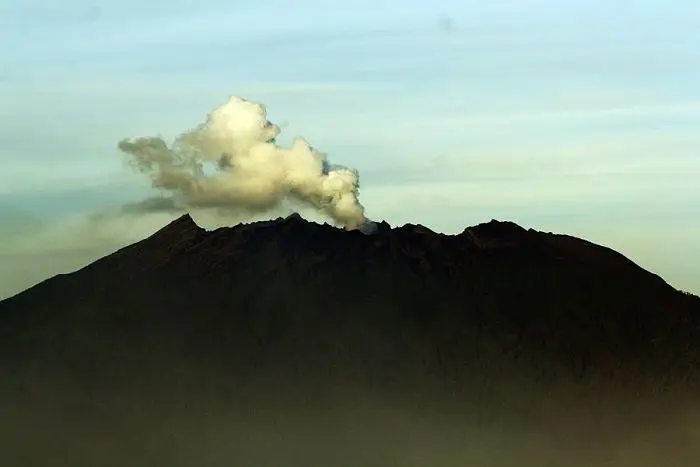
Climbing Tambora means walking to the edge of the greatest natural disaster in written history. In April 1815 this volcano on the island of Sumbawa exploded with ten times the power of Krakatau in 1883. It killed tens of thousands of people, wiped out entire kingdoms and plunged the northern hemisphere into "the year without a summer".
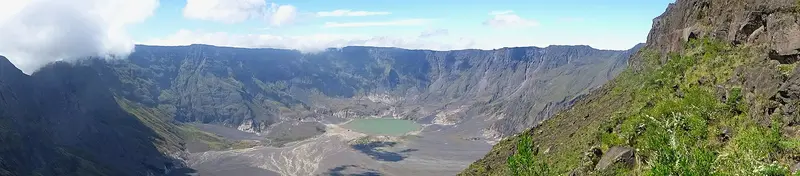
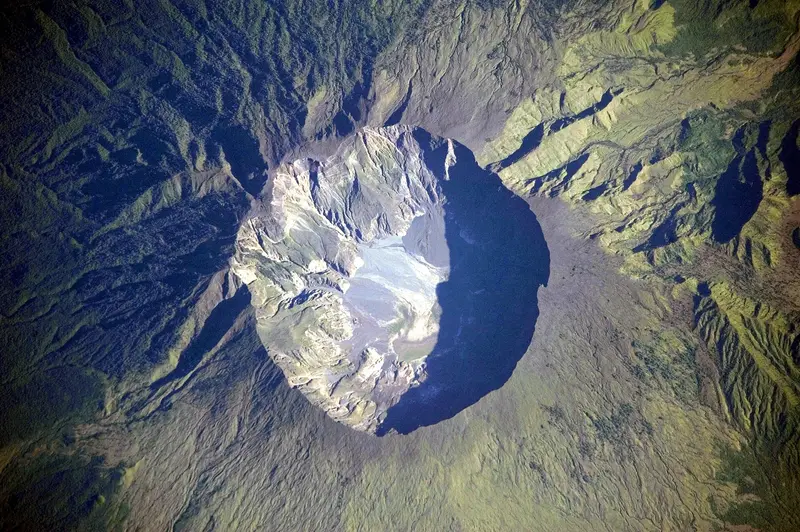
What remains is one of the most impressive landscapes in Indonesia: a caldera 6 km wide and more than 1,100 m deep, whose rim you reach after two days' walking through forest or savannah. At the bottom, a small lake, a steaming parasitic cone, and silence. You are often alone.
Tambora is not technically difficult, but it is long, hot in its lower part and far from everything. That is exactly what makes it an adventure.
Tambora at a glance
| Elevation | 2,850 m (about 4,000 m before 1815) |
|---|---|
| Caldera | 6 km wide, 1,100 to 1,250 m deep |
| Type | Trachybasaltic stratovolcano covering the whole Sanggar peninsula |
| 1815 eruption | VEI 7, more than 150 km³ of material, about 60,000 to 70,000 dead |
| Management | Tambora National Park (created in 2015) |
| Routes | Pancasila (north-west), Doro Ncanga (south), Kawinda Toi, Piong |
| Time | 2 to 3 days |
| Alert level | II (Waspada) in November 2026 |
Is Tambora open?
The box next to this article gives today's status.
- The trails have been closed since 1 September 2026, like those of eight other national parks, because of the forest-fire risk. No reopening date has been announced; some local agencies do not expect a restart before the 2027 season.
- The volcano is at level II (Waspada). The MAGMA report of 15 November 2026 advises against entering a 3 km radius around the centre of activity, going down to the caldera floor, or approaching the Doro Afi Toi and Doro Afi Bou parasitic cones and gas vents, and warns of rockfalls from the walls.
In practice, when the park is open, you climb to the caldera rim, but no longer to the floor.
When to go
From mid-May to mid-October, in the dry season. The rainy season makes the tracks impassable and fills the forest with leeches. The end of the dry season brings a fire risk, as in 2026.
Getting to Tambora
Tambora is in the north of Sumbawa, between Lombok and Flores. You reach Sumbawa by plane to Bima (flights from Lombok, Bali, Jakarta) or by ferry from Lombok (Kayangan – Poto Tano). From Bima it is 4 to 6 hours by road to the trailheads, on roads that are sometimes rough.
The routes
Via Pancasila, the historic route
The village of Pancasila, to the north-west among coffee plantations, is the oldest starting point. The route crosses dense, humid rainforest with five shelters (pos), then a zone of casuarinas and ferns. It takes two to three days: a long first day to pos 3 or 4, a night start for the caldera rim, then the descent. It is the steepest, wildest and hardest route.
Via Doro Ncanga, the savannah route
To the south, the Doro Ncanga route crosses a vast savannah grazed by horses and buffalo. It is considered the simplest logistically, with the option of covering part of it by four-wheel drive or motorbike. More exposed to the sun, it offers magnificent views of the sea and of Tambora all the way up.
At the caldera rim
All routes arrive at the caldera rim, at around 2,700–2,850 m. The view drops more than a thousand metres to a flat floor, with a small lake and the parasitic cones. A very steep path used to go down to the floor: it is forbidden at level II.
How much does the climb cost?
A national park entry permit is required, usually included in local guides' packages, which also arrange transport, porters and camp. The park has no online booking system. A local guide is essential, both for navigation and for permits.
We do not run Tambora trips. For a big, wild, multi-day volcano, see Raung or Semeru.
The 1815 eruption
The awakening
Tambora was thought to be extinct. In 1812 it began to rumble and emit ash. On 5 April 1815 a first explosion was heard as far as Batavia (Jakarta), 1,260 km away: the authorities thought it was cannon fire and sent troops.
The climax
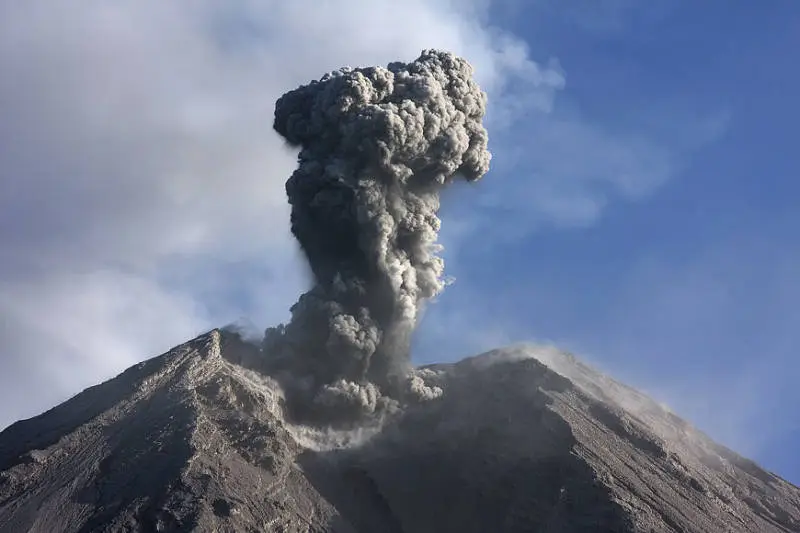
On the evening of 10 April 1815 the eruption reached its climax. Three columns of fire rose above the volcano and merged. Pyroclastic flows swept down every flank and reached the sea. The detonations were heard 2,600 km away. The volcano emptied and collapsed on itself: it lost more than 1,000 m of height and left the present caldera. Tsunamis struck the nearby coasts. It was pitch dark for two days up to 600 km away.
The toll
An estimated more than 150 km³ of ash and rock was thrown out: the largest eruption in written history (VEI 7). Pyroclastic flows killed about 11,000 to 12,000 people on the peninsula. The famine and epidemics that followed killed tens of thousands more on Sumbawa and Lombok. Total estimates range from 60,000 to over 70,000 dead. The kingdoms of Tambora and Pekat disappeared.
The year without a summer
The sulphur aerosols injected into the stratosphere circled the globe. In 1816 Europe and North America lived through "the year without a summer": snow in June in New England, failed harvests, famine in Europe, food riots. On the shores of Lake Geneva, under endless storms, Mary Shelley wrote Frankenstein and Lord Byron the poem Darkness. The glowing sunsets of those years are said to appear in the paintings of William Turner.
The "Pompeii of the East"
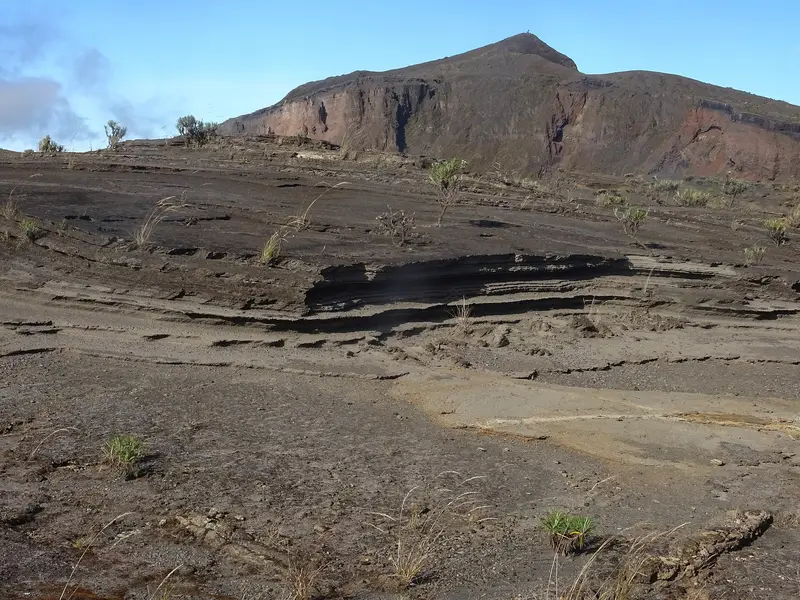
In 2004 a team of volcanologists and archaeologists led by Haraldur Sigurdsson excavated the 1815 deposits near the village of Tambora and uncovered the remains of houses, pottery and bones buried under three metres of ash. The newspapers called it the "Pompeii of the East".
The history of the climb
The first known European to climb Tambora after 1815 was the Swiss botanist Heinrich Zollinger, in 1847, who described the caldera and the slow return of vegetation. In the 20th century the climb remained rare, reserved for scientists and a few hikers. In 2015, for the bicentenary of the eruption, Tambora became a national park, and the government developed the Doro Ncanga and Pancasila routes.
The volcano
Tambora is a huge stratovolcano covering the whole Sanggar peninsula, 60 km wide. It reached about 4,000 m before forming a first caldera more than 43,000 years ago. Lava flows later filled it, then activity turned explosive at the start of the Holocene, up to 1815. Its magma, a potassium-rich trachybasalt, is unusual for Indonesia. Since 1815, small domes and lava flows have formed on the caldera floor.
The eruptions of Tambora
The Smithsonian records 7 eruptions, including three prehistoric ones dated by carbon 14 (around 3910 and 3050 BCE, and around AD 740).
1812-1815. The great eruption (VEI 7).
1819. A small eruption.
1880. An eruption at the Doro Afi Toi cone, in the south-western part of the caldera.
1967. A small effusive eruption in the north-east of the caldera floor.
Since 2011. Several spells at level II because of earthquakes and degassing. In November 2026, the MAGMA report records 21 deep volcanic earthquakes and rockfalls in 24 hours.
Full timeline: 7 recorded eruptions
| Start | End | VEI | Location |
|---|---|---|---|
| 1967-07-02 | ? | 0 | NE part of caldera floor |
| 1880-07-02 | ? | 2 | SW part of caldera (Doro Afi Toi) |
| 1819-08-16 | ? | 2 | |
| 1812-07-02 | 1815-07-15 | 7 | |
| 740 | ? | – | |
| 3050 BCE | ? | – | |
| 3910 BCE | ? | – |
Source: Smithsonian Institution, Global Volcanism Program. VEI = Volcanic Explosivity Index, from 0 (effusive) to 8 (supervolcano); each step means ten times more material.
Frequently asked questions
Can Tambora be climbed in 2026?
The trails have been closed since 1 September 2026 because of the fire risk, with no announced reopening date. The volcano is at level II: when the park reopens, you will climb to the caldera rim, not the floor.
How many days does it take?
Two to three days depending on the route, plus the journey from Bima or Lombok (a day each way).
Which route should I choose?
Doro Ncanga for the savannah, the view and simpler logistics; Pancasila for the forest, the history and the adventure.
What was the largest eruption in history?
Tambora in 1815, with more than 150 km³ of material and a VEI of 7. Some prehistoric eruptions, such as Toba in Sumatra 74,000 years ago, were far larger.
Why was 1816 "the year without a summer"?
Because Tambora's sulphur aerosols, injected into the stratosphere, reflected part of the sunlight and lowered northern-hemisphere temperatures by about half a degree to one degree, with icy summers and failed harvests in Europe and North America.
Sources
- MAGMA Indonesia (PVMBG), Tambora activity report of 15 November 2026
- Smithsonian Institution, Global Volcanism Program, Tambora (264040)
- Antara (trail closure, September 2026)
- Gillen D'Arcy Wood, Tambora: The Eruption That Changed the World (2014)
- Sigurdsson H. et al., 2004 excavations at the Tambora site (University of Rhode Island)
Article updated on 16 November 2026