Why Gede and Pangrango
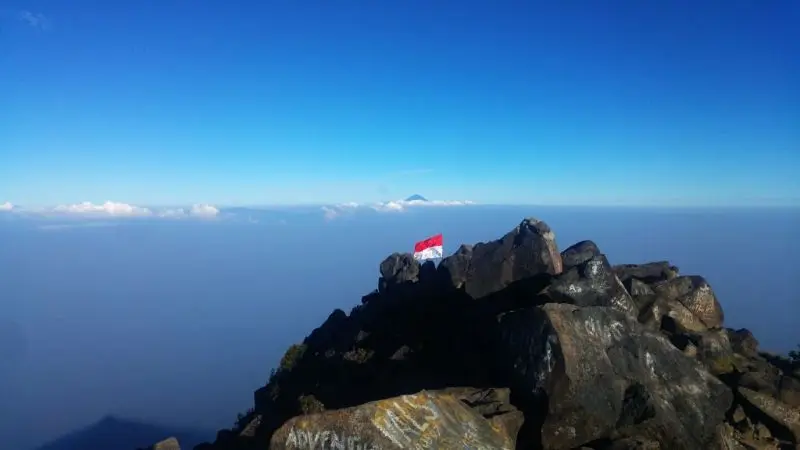
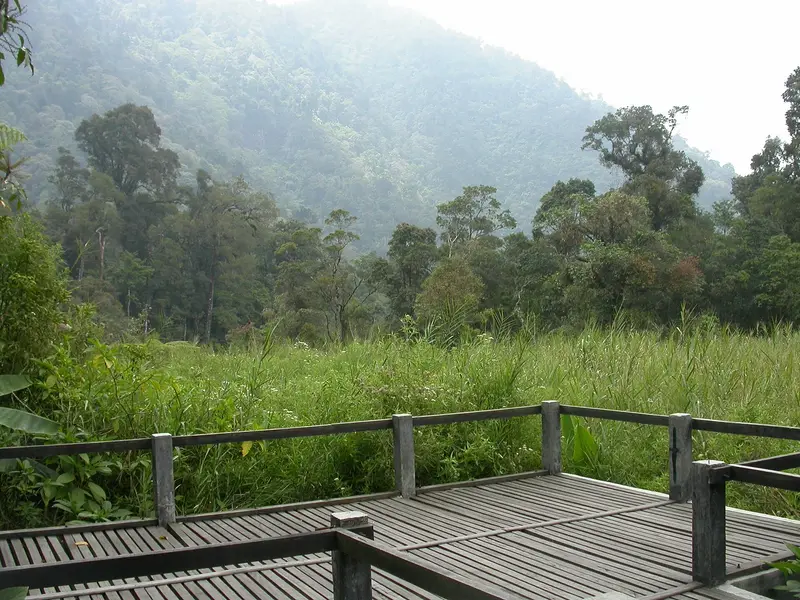
For millions of people in Jakarta, Bogor and Bandung, Gede-Pangrango is their first mountain. And it is a very fine mountain. You cross one of the best-preserved cloud forests in Java, pass a hot waterfall steaming in the middle of the jungle, camp at the foot of an active volcano, and come out at sunrise onto Surya Kencana, a large high meadow covered in Javanese edelweiss.
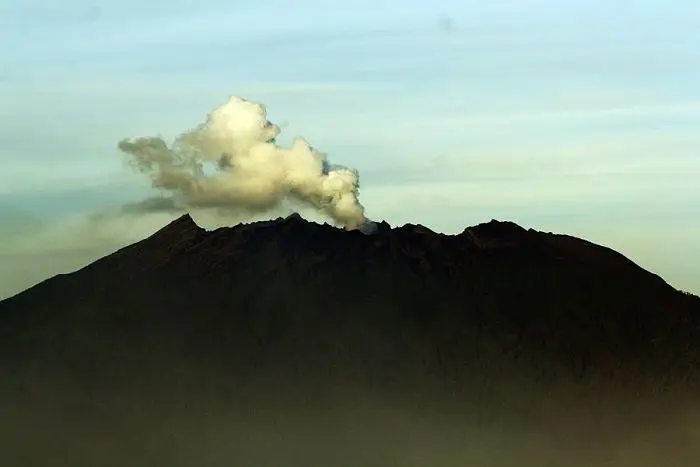
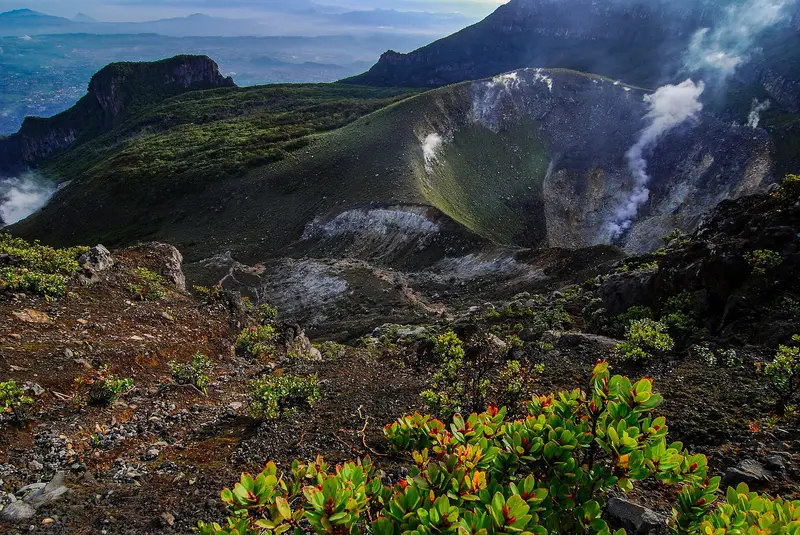
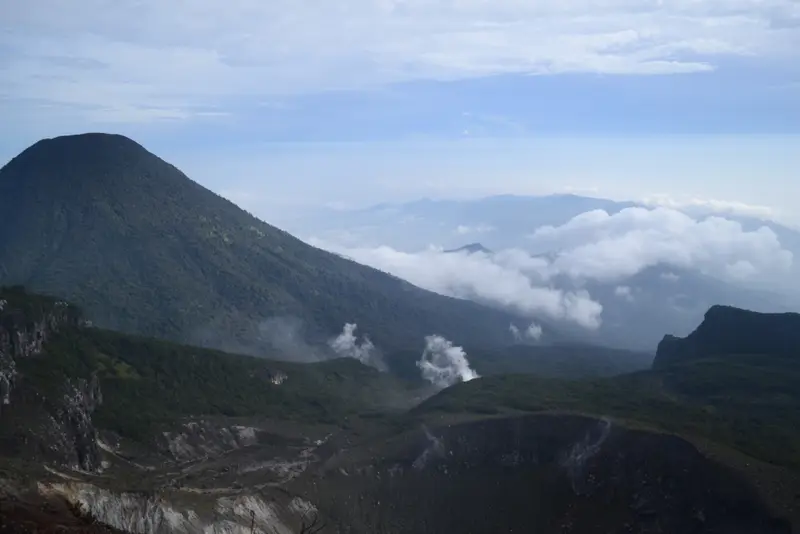
Each summit has its own character. Gede (2,958 m) is an active volcano, with a grey and yellow crater steaming above a ravine. Pangrango (3,019 m), higher, is extinct and entirely forested; at its top lies the small clearing of Mandalawangi, celebrated by the poet Soe Hok Gie.
It is also a place where scientists have studied tropical mountain forest for two centuries, thanks to the Cibodas botanical garden at its foot.
Gede-Pangrango at a glance
| Elevations | Pangrango 3,019 m; Gede 2,958 m |
|---|---|
| Type | Complex of stratovolcanoes; Gede is active |
| Active craters | Kawah Ratu, Kawah Lanang, Kawah Wadon |
| Eruptions | 26 recorded; the latest in 1957 |
| Management | Gunung Gede Pangrango National Park (TNGGP), created in 1980 |
| Routes | Cibodas, Gunung Putri (Cianjur), Selabintana (Sukabumi) |
| Time | 2 days / 1 night |
| Quota | 300 hikers a day at the April 2026 reopening |
| Alert level | I (normal) in November 2026 |
Is Gede-Pangrango open?
The box next to this article gives today's status.
- The park reopened on 13 April 2026 after six months of closure, with a quota of 300 hikers a day across the three routes and a new RFID wristband system.
- It closed again on 1 September 2026, with no end date, because of the fire risk, and the closure was later extended.
- The volcano is at level I. The PVMBG advises against going down into the Gede crater, approaching it or camping within 600 m of it.
The park also traditionally closes every year at the start of the year (rainy season) and for part of August.
Booking and rules
- Online booking is compulsory on the park website, with quotas per route.
- A recent medical certificate is required.
- Entrance fee for a foreigner: about 435,000 IDR (≈ 22 €) for a 2-day, 1-night climb, according to the latest published rates (late 2024).
- Rubbish checks and a ban on fires.
When to go
From April to October, in the dry season, outside the closures. West Java is one of the wettest regions of Indonesia: even in the dry season, afternoons are often in cloud. Nights at Kandang Badak and Surya Kencana are close to 5 °C.
Getting there
The park is 2 h 30 to 3 hours from Jakarta and 2 hours from Bandung, depending on traffic (often dreadful at weekends on the Puncak road). The trailheads are:
- Cibodas (Cianjur), to the north, next to the botanical garden;
- Gunung Putri (Cianjur), a few kilometres from Cibodas;
- Selabintana (Sukabumi), to the south.
The routes
Cibodas, the classic route
The finest and best-documented route. From the park entrance (1,300 m) you pass the small lake Telaga Biru, then the Cibeureum waterfall (15-minute detour), before crossing the famous Air Panas: a hot torrent running over the trail in a cloud of steam, crossed holding a rope. You camp at Kandang Badak (2,400 m), on the saddle between the two volcanoes. The next day you climb Gede (2 hours, with a rocky passage called Tanjakan Setan, "the devil's climb") or Pangrango (3 hours through forest).
Gunung Putri, the Surya Kencana route
Shorter and steeper, the Gunung Putri route leads straight to the Surya Kencana meadow (2,750 m), over a kilometre long and covered in Javanese edelweiss (Anaphalis javanica), which must not be picked. You camp there, then climb to the summit of Gede in an hour. The Gunung Putri – Gede – Cibodas traverse is the finest loop in the park.
Selabintana, the wild route
To the south, the Selabintana route is the longest and least used, through very dense forest. It joins Surya Kencana.
The craters of Gede
From the summit of Gede you look down on three craters: Kawah Ratu, Kawah Lanang and Kawah Wadon. They steam, smell of sulphur, and their walls regularly collapse. You look at them from above, without going down.
Mandalawangi
At the top of Pangrango, the Mandalawangi clearing is covered in edelweiss and moss. It was the favourite place of Soe Hok Gie, the student and poet who died on Semeru in 1969, and who dedicated a famous poem to it, Mandalawangi – Pangrango.
Map and GPX track
- Cibodas → Kandang Badak → sommet du GedeDistance 8.9 km · Elevation gain 1,550 m · Start 1,383 m → High point 2,907 mDownload the GPX track ↓
Indicative route from OpenStreetMap; elevations from Copernicus. Check on the ground and follow your guide. © OpenStreetMap, OpenTopoMap (CC-BY-SA), Open-Meteo.
How much does the climb cost?
The entrance fee, about 435,000 IDR (≈ 22 €) for two days, is paid when you book. Add transport, the medical certificate and, if you wish, a guide and porters, who can be found in Cibodas.
We do not run Gede-Pangrango trips. For a similar climb in East Java, see Arjuno-Welirang.
The history of Gede-Pangrango
Gede-Pangrango is the most studied mountain in Indonesia. The Cibodas botanical garden, founded in 1852 as an annex of the Buitenzorg (Bogor) garden, has served as a base for generations of botanists, zoologists and geologists. Franz Wilhelm Junghuhn and other naturalists explored both summits in the 19th century. In 1889 the Dutch created a nature reserve here, one of the first in Asia.
In 1980 Gede-Pangrango became one of Indonesia's first five national parks. It is also a UNESCO biosphere reserve, within the Cibodas reserve. The name of the Kandang Badak camp, "the rhinoceros pen", recalls that the Javan rhinoceros still lived on these slopes in the 19th century.
The volcano
The complex overlooks the towns of Cianjur, Sukabumi and Bogor. Pangrango, the highest point, was built on the north-east rim of a 3 × 5 km caldera. Gede, younger, lies to the south-east; many lava flows can be seen on its flanks. Its summit crater has migrated about a kilometre north-north-west over time. Two large debris-avalanche deposits cover its flanks; the town of Cianjur is built on one of them.
The eruptions of Gede
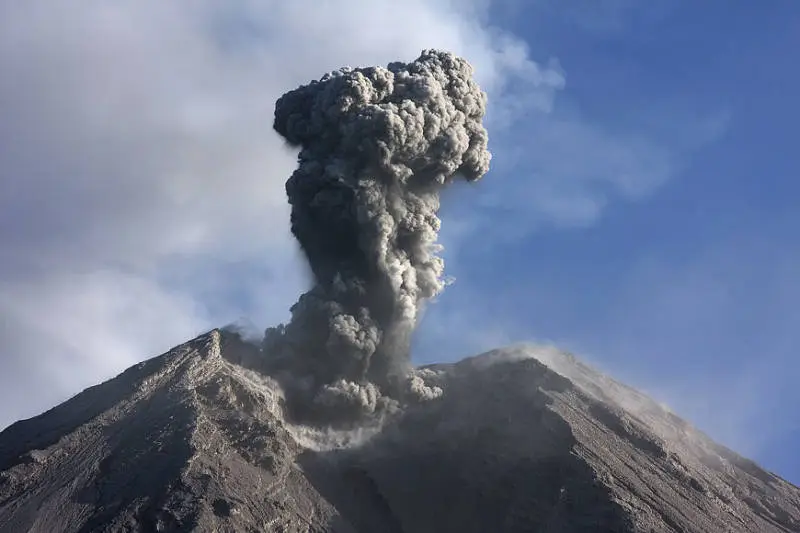
The Smithsonian records 26 eruptions since the 16th century, almost all short, small explosions.
1747-1748, 1832, 1840, 1853. The strongest (VEI 3), with ash fall and blocks around the crater.
1840-1900. An eruption every two to five years.
1947-1949. Explosions at Kawah Ratu and Kawah Lanang.
1956-1957. The last explosive eruptions (VEI 2).
The PVMBG monitors Gede from the Cibodas observatory. The MAGMA report of 15 November 2026 notes only one tornillo-type earthquake and two distant tectonic earthquakes.
Full timeline: 26 recorded eruptions
| Start | End | VEI | Location |
|---|---|---|---|
| 1957-03-13 | 1957-03-13 | 2 | |
| 1956-04-28 | 1956-04-28 | 2 | |
| 1955-07-21 (uncertain) | 1955-08-02 | 1 | |
| 1948-11-15 | 1949-02-05 | 2 | Kawah Leutik (Kawah Ratu) |
| 1947-09-02 | 1948-01-28 | 2 | Kawah Ratu?, Kawah Lanang |
| 1909-05-02 | 1909-05-02 | 1 | |
| 1899-05-01 | 1899-05-14 | 2 | |
| 1891-07-02 | ? | 2 | |
| 1889-05-08 (uncertain) | ? | 1 | |
| 1888-07-02 | ? | 2 | |
| 1887-10-22 | 1887-10-22 | 2 | |
| 1886-06-10 | 1886-08-16 | 2 | |
| 1885-01-16 (uncertain) | 1885-02-16 | 2 | |
| 1870-08-16 | 1870-10-03 | 2 | |
| 1866-09-18 | ? | 2 | |
| 1853-03-14 | 1853-03-14 | 3 | |
| 1852-05-28 | 1852-05-28 | 2 | |
| 1848-05-08 | ? | 2 | |
| 1847-10-17 | 1847-10-18 | 2 | |
| 1845-01-23 | 1845-03-05 | 2 | |
| 1843-07-28 | ? | 2 | |
| 1840-11-12 | 1840-12-11 | 3 | |
| 1839-07-02 (uncertain) | ? | – | |
| 1832-08-29 | 1832-08-29 | 3 | |
| 1761 | ? | 2 | |
| 1747 | 1748 | 3 |
Source: Smithsonian Institution, Global Volcanism Program. VEI = Volcanic Explosivity Index, from 0 (effusive) to 8 (supervolcano); each step means ten times more material.
Frequently asked questions
Gede or Pangrango?
Gede for the steaming craters and the Surya Kencana meadow; Pangrango for the forest, the quiet and Mandalawangi. Many hikers do both from Kandang Badak.
Is the park open?
It has been closed since 1 September 2026, with no announced reopening date. It usually reopens in spring, with online booking and quotas.
How much does the climb cost for a foreigner?
About 435,000 IDR (≈ 22 €) for two days according to the latest published rates, plus transport and any guides and porters.
Can you pick the edelweiss?
No. Javanese edelweiss is protected, and picking it is punished with a fine.
Is Gede dangerous?
Gas and collapses in the crater are the main risks, hence the ban on going down into it. Crossing the Air Panas needs a little care.
Sources
- MAGMA Indonesia (PVMBG), Gede activity report of 15 November 2026
- Smithsonian Institution, Global Volcanism Program, Gede-Pangrango (263060)
- Balai Besar TNGGP; Metro TV (reopening of 13 April 2026); Antara (closure) and extended closure, September 2026; Detik (fees, 2024)
Article updated on 16 November 2026